

Ishani Ghoshal
2 September 2026
How we create a Canonical Academy exam
Open source provides the world with access to cutting-edge software, and the learning that comes with it. But how do you validate someone’s skills in an open ecosystem?
Canonical Academy is a highly rigorous, job-focused qualification platform designed to empower individuals and enterprises with industry-recognized credentials. The platform addresses a critical gap in tech: validating real-world, hands-on capability rather than rote memorization.
Rather than generic certifications, our approach focuses on specialized learning paths broken down into core modular exams. Taking our System Administration track consists of four sequential, timed, and hands-on proctored assessments. Candidates can earn badges for individual exams – Using Linux Terminal, Using Ubuntu Desktop, Using Ubuntu Server, or Using DevOps Principles – and if they complete the full set of exams, they unlock the comprehensive, track-level qualification. This structured approach gives modern engineering teams a clear blueprint for onboarding, career progression, and upskilling, matching today’s dynamic employment market.
Inside the blueprint: how we build high-fidelity exams
To understand what differentiates a Canonical Qualification, you have to look inside our development process. We build exams with the day-to-day realities of qualified tech professionals. Our rigorous exam creation framework follows an exact ADDIE iteration cycle engineered to yield highly credible and error-tolerant assessments.
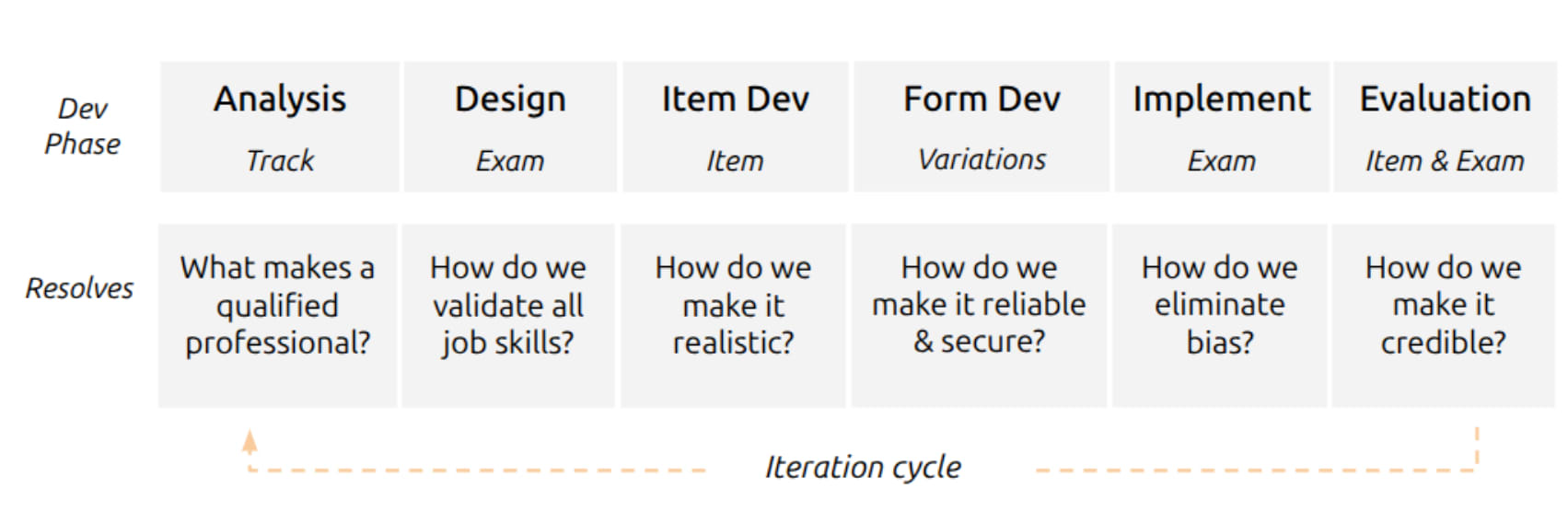
- Analysis phase (track level): We begin by executing an intensive Job Task Analysis (JTA) survey. Subject Matter Experts (SMEs) are surveyed to isolate the critical, high-frequency responsibilities native to the target role.
- Design phase (exam level): Armed with JTA insights, we draft a tight qualification Blueprint defining assessment objectives and identifying complementary Learning Objectives (LOs).
- Item development phase (item level): Content managers and expert engineers prototype actual hands-on test items, including terminal-based live lab exercises, which undergo strict internal code reviews for clinical technical accuracy.
- Form development phase (variations level): We establish multiple distinct variations of questions and use variables in individual items to ensure security and reliability while engineering specific automated scoring scripts.
- Implementation phase (exam level): Assessments proceed through private Alpha and public Beta periods to stress-test real-world performance. This lets us evaluate timing data and calculate fair psychometric cut scores based on verified tester results.
- Evaluation phase (ongoing quality check): Continuous feedback and direct user exit surveys, run persistently post-launch, guaranteeing that exams maintain long-term alignment and clinical relevance.
Engineered for real-world industry relevance
Modern enterprises have grown skeptical of multiple-choice certifications that can be easily memorized or side-stepped using AI prompts. Organizations want certifications that validate what their employees can do on the job. Canonical Academy was launched to bridge this exact gap.
Our assessments avoid artificial test environments. Candidates are evaluated directly within sandbox instances running on identical production infrastructure they will face in the workplace. The exam delivery system demands active execution, such as spinning up an environment, altering production network stacks, or automating scripts via python or bash, while granting full, native access to documentation and documentation man pages just like on the job.
This means that candidates are evaluated in an environment with infrastructure that resembles what they would find in a real workspace. For instance, they could be spinning up containers, altering network stacks, or writing automated scripts in the exam, while being able to access product documentation and man pages just like on the job.
Furthermore, our blueprint explicitly balances core open source tooling with specialized workflows (for instance, LXD with Docker Compose or NFS and Samba with enterprise integrations like Active Directory), preparing developers and administrators for cross-functional roles.
By putting individuals through rigorous, realistically timed problem sets, an employer can immediately trust that a certified individual possesses verified execution capabilities.
Shape the future by becoming a Canonical Academy SME
The strength of any certification lies entirely in the expertise of its developers. To build authentic tracks, we regularly source a diverse panel of qualified technical professionals, both internally from Canonical and externally, to consult directly on future content development pipelines.
We are actively recruiting Subject Matter Experts (SMEs) to help refine upcoming focus areas, including cloud architecture, security virtualization, and DevOps tracks. The selection process targets active practitioners: mid-to-senior engineers, site reliability engineers (SREs), and experienced system administrators who maintain active hands-on experience.
As an active SME, you can participate flexibly based on your availability, whether through structured, interactive content-development workshops or asynchronous GitHub code reviews on question prototypes. Your unique perspective will directly combat structural bias and ensure high credibility.
Ready to contribute to the global open-source community?
- Connect directly with our team on our official channel: Join the Canonical Academy Matrix channel
- Become an SME
- Become a tester

